
Power 101: What Data Center Operators Need to Know About the Grid Interconnection Crisis
If you are developing a data center in 2026, you already know the build side of the equation is largely solved. Modular and prefabricated data center infrastructure has compressed construction timelines dramatically; containerized edge units can be operational within 4 to 10 weeks of on-site delivery, while prefabricated room-scale modules typically run 12 to 24 weeks from contract to installation, according to industry deployment data. Traditional builds that once required 24 to 36 months now commonly land between 16 and 20 months when modular strategies are applied, per CMIC Global's 2026 construction trends analysis. The construction problem is no longer the primary constraint.
The power problem is.
The United States electrical grid is operating under demand pressure it was not designed to handle. AI workloads, fleet electrification, and industrial reshoring are generating simultaneous power requirements that utilities cannot absorb at the pace enterprises need. For data center developers and operators specifically, the result is a growing crisis: compute infrastructure is ready to generate revenue, and the power to run it is years away.
For data center developers, the interconnection gap is a revenue problem disguised as an infrastructure problem. The solution is not to wait. It is to deploy on-site energy infrastructure that powers the facility now and integrates with the grid later. This article explains how Battery Energy Storage, PowerHub generation, and hybrid configurations work at each stage of that journey.
The Grid Interconnection Queue Is a Data Center Business Problem
The US interconnection queue is the process by which new power projects, including the utility connections data centers require, get approved, studied, and connected to the grid. It is not a minor administrative process. It is a multi-year infrastructure bottleneck that has become the defining constraint on data center development in 2026.
How Big Is the Backlog?
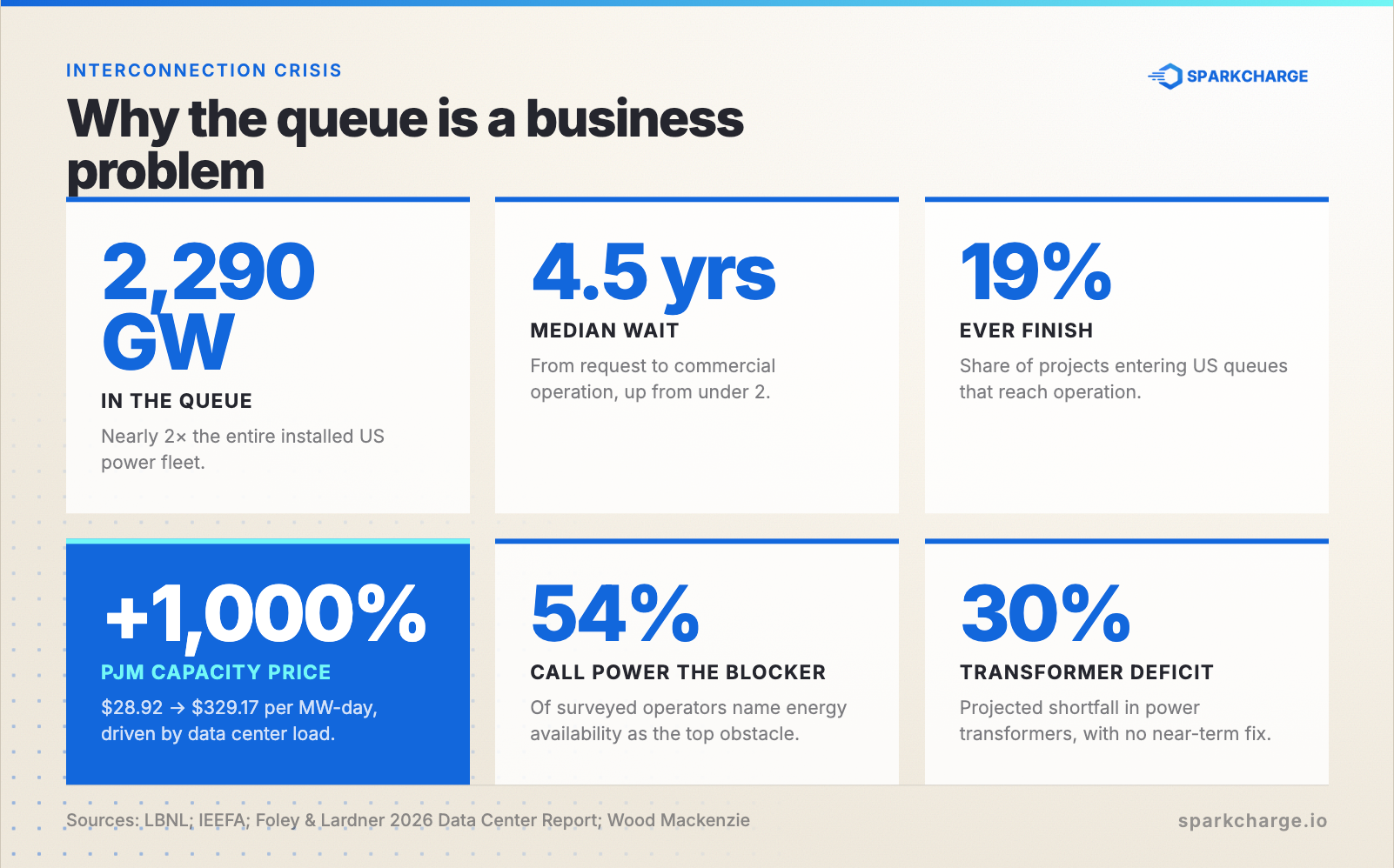
As of the end of 2024, approximately 2,290 GW of generation and storage capacity remained active in US interconnection queues, representing nearly twice the total installed capacity of the current US power plant fleet (according to the Lawrence Berkeley National Laboratory's 2025 Queued Up report). The peak of the backlog reached nearly 2,600 GW when measured against end-of-2023 submissions.
The median time from interconnection request to commercial operation for projects that actually reached completion in 2024 was approximately 4.5 years, up from under two years a decade ago, per the same LBNL report. Historically, only about 19% of projects entering US queues have reached commercial operation at all.
The capacity market signal is equally stark. PJM Interconnection, which manages the grid for more than 65 million people across 13 states, has seen capacity auction prices hit record highs in three consecutive auctions. Prices rose from $28.92 per megawatt-day in the 2024/2025 delivery year to $329.17 in 2026/2027, an increase of more than 1,000%, driven significantly by data center load, according to analysis from the Institute for Energy Economics and Financial Analysis (IEEFA).
Why Data Centers Wait Longer Than Anyone Else
Not all grid interconnection requests move at the same pace. Data centers require large, sustained power draws at high power density, placing them in a more complex review category than smaller commercial connections. Utilities must study the impact of large load additions on grid stability, conduct multiple rounds of engineering analysis, and often require significant substation upgrades before approving a connection.
The Foley and Lardner 2026 Data Center Development Report, which surveyed 105 US-based data center developers, providers, and operators, found that 54% of respondents identified energy availability and redundancy as the greatest obstacle to successful data center development between now and 2030. That figure reflects a shift from prior years when permitting and capital were the leading constraints. Power is now the gating factor.
What Is Bridge Power for Data Centers?
Bridge power is on-site energy infrastructure deployed to power a facility during the period between when it is built and when its permanent grid connection is active. The term comes from the concept of bridging the gap between two states: pre-grid and grid-connected.
For data centers, bridge power is what allows compute racks to go online, cooling systems to operate, and revenue to begin flowing before a utility interconnection is complete. It is not a backup power system. It is not a generator for emergencies. It is a primary power source designed to run a data center continuously until the permanent grid connection arrives.
Bridge Power vs. Emergency Power
This distinction matters operationally and financially. Emergency power systems, traditional diesel generators and UPS infrastructure, are designed for short-duration events: utility outages, brief service interruptions, load transitions. They are sized and priced for hours of runtime, not years.
Bridge power infrastructure is designed for the opposite use case. It must operate as a primary energy source for months or years, deliver consistent power quality sufficient for sensitive compute loads, handle thermal and cooling demands at scale, and do so cost-effectively over a multi-year operating horizon.
Using emergency backup infrastructure as a bridge power solution is technically possible in some configurations but is rarely the right economic answer over a multi-year timeframe.
Behind the Meter vs. Grid-Connected Power
Bridge power for data centers typically operates behind the meter, meaning the infrastructure is installed on the customer's side of the utility connection point. Behind-the-meter (BTM) systems give the operator direct control over energy dispatch, allow for demand charge management, and in some configurations enable participation in wholesale energy markets.
Grid-connected bridge power, where a temporary utility feed is established pending a permanent connection, is another option but faces the same interconnection queue constraints as a permanent connection in many markets. BTM on-site generation and storage is frequently the faster path to power.
The Business Case for Bridge Power
Understanding bridge power as a technical category is useful. Understanding it as a financial decision is more important. For most data center developers and operators, the bridge power question is not "can we do this"; it is "what does waiting actually cost us?"
Delayed Compute Is Delayed Revenue
A data center that cannot power its compute racks cannot generate revenue. For hyperscale and colocation operators, this is straightforward: empty racks are a direct cost against leased capacity commitments. For enterprise operators deploying AI infrastructure, delayed compute means delayed model training, delayed product development, and delayed competitive positioning.
The financial model of most data center development assumes a ramp period between facility delivery and full-capacity operation. When that ramp period is extended by years of grid delay, the financial impact compounds. Development debt accrues. Opportunity cost accumulates. And in markets where AI compute capacity is constrained, the competitive cost of being offline for additional years is difficult to quantify but easy to feel.
Bridge power converts a waiting period into a revenue-generating period. That reframing changes the financial calculus entirely.
Transformer Lead Times Are Making It Worse
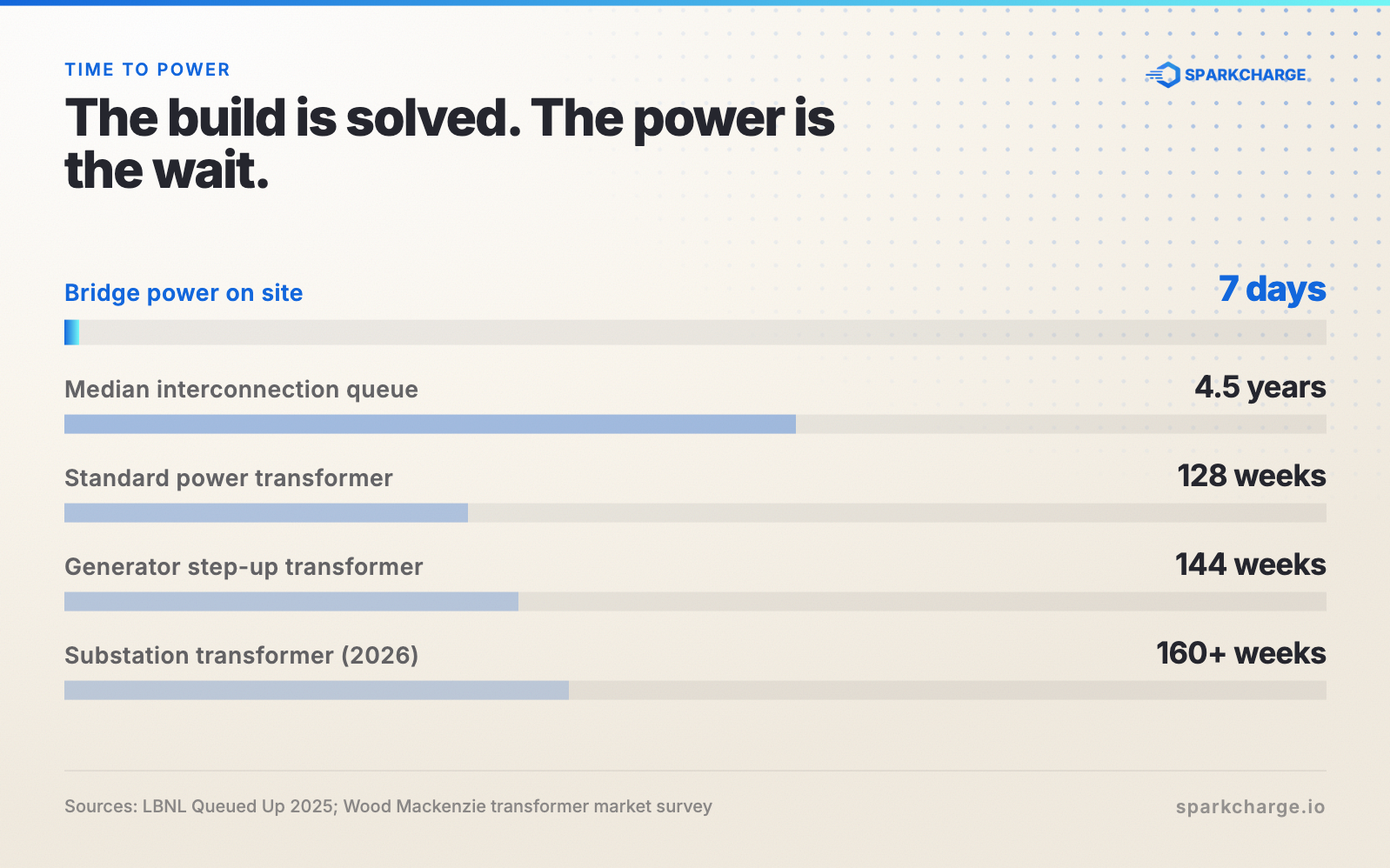
Even for developers and operators who have secured grid interconnection approval, transformer availability has become a secondary bottleneck. According to Wood Mackenzie's Q2 2025 transformer market survey, standard power transformers averaged 128 weeks (roughly 2.5 years) for delivery, with generator step-up transformers averaging 144 weeks (nearly three years). Substation transformer lead times have continued to stretch, reaching more than 160 weeks in 2026, according to Wood Mackenzie research cited by Data Center Knowledge. Some high-voltage transformer orders are now quoting 36 to 48 months.
This means that even a data center with a confirmed utility interconnection date may face additional delays waiting for the physical transformer hardware required to complete the connection. Bridge power that was originally planned as a 12-month gap-filler may need to operate for 24 to 36 months or longer.
Planning bridge power capacity and duration against the realistic transformer delivery timeline, not just the interconnection approval date, is increasingly important for developers and operators building financial models on new developments.
On-Site Energy Solutions That Work Before, During, and After Grid Connection
The data centers getting to revenue fastest in 2026 are not waiting for utility confirmation before making energy decisions. They are deploying Battery Energy Storage, on-site generation, and hybrid systems that operate as primary power now and integrate with the grid later. The infrastructure does not change. Its role evolves.
Battery Energy Storage Systems (BESS)
Battery Energy Storage Systems (BESS) are the most strategically flexible infrastructure choice for data center operators. BESS units store energy and dispatch it on demand, providing clean, stable power with the quality characteristics that sensitive compute loads require. Mobile and modular configurations deploy without permanent site infrastructure and can be operational within days of arriving on site.
During the pre-grid phase, BESS operates by delivering energy as a primary power source. Racks stay online. Cooling systems run. Revenue generation starts. The facility does not wait.
The more important story is what happens when the grid connection arrives.
Rather than being decommissioned, BESS integrates directly with the utility connection and transitions into a permanent grid-tied asset. In this configuration, it continues to operate as a power booster, absorbing excess grid capacity during off-peak hours when electricity is cheap, then dispatching stored energy during peak demand windows to supplement what the grid connection alone can deliver. A facility with a 5 MW utility connection and a properly sized BESS deployment can effectively operate at 7 or 8 MW of usable capacity without upgrading the interconnection itself.
This matters because interconnection upgrades are expensive, slow, and subject to the same queue constraints that created the gap in the first place. BESS solves the capacity ceiling without triggering a new utility process.
Grid-tied BESS also eliminates demand charge exposure. Utilities bill commercial customers based on peak draw within a billing period. A single 15-minute spike can set the demand charge for the entire month. BESS caps that spike automatically, with the energy management system dispatching storage at the precise moment peak demand would otherwise be charged.
The final layer is revenue. Behind-the-meter BESS that participates in demand response and wholesale energy market programs can generate income from capacity that would otherwise sit idle overnight. The same asset that powered the facility before the grid arrived is now reducing the utility bill and generating revenue after it does.
On-Site Generation
Fuel-based on-site PowerHub generation provides continuous power output that does not depend on stored capacity. Generation systems are sized to match site load and can run indefinitely as long as fuel supply is maintained.
For data center power applications, generation systems offer the continuous runtime that BESS alone cannot provide. They are particularly well suited to sites where grid access is years away, where load is high and consistent, and where fuel logistics are manageable.
Hybrid BESS and Generation Systems
The most capable bridge power configurations combine BESS and generation infrastructure. In a hybrid system, generation provides continuous baseline power while BESS handles peak demand, power conditioning, and load smoothing. Intelligent energy management software coordinates the two systems in real time, optimizing for cost, efficiency, and reliability.
For data center operators, hybrid systems offer several advantages over either BESS or generation alone: better power quality than generation alone, continuous runtime beyond what BESS can provide, lower emissions than generation-only configurations through optimized dispatch, and the ability to participate in demand response and energy market programs through BESS.
Hybrid systems also provide a natural transition path. As grid connection approaches, the generation component can be scaled back while BESS handles the residual gap and ultimately transitions to grid backup or energy market participation once the permanent connection is live.
Key Questions to Ask Before Selecting a Power Solution
Before engaging power vendors, data center developers and operators benefit from having clear answers to the following:
What is the confirmed interconnection date, and what is the realistic date?
Utility-provided interconnection timelines are subject to change, and transformer lead times can add 12 to 36 months beyond the interconnection approval date. Planning power duration against the realistic power-on date, not the optimistic interconnection date, prevents being caught short.
What is the site load profile?
Peak demand, average utilization, thermal load, and load growth as racks are added all affect power sizing. A system sized for initial rack density may be insufficient at full build-out.
What are the local fuel options?
On-site generation requires fuel logistics. Natural gas pipeline access, propane delivery feasibility, and RNG availability vary significantly by site location and affect both cost and emissions profile.
What are the emissions constraints?
Local air quality regulations, corporate carbon commitments, and utility requirements for grid interconnection may constrain fuel-based generation options. Understanding these constraints before selecting a power approach avoids expensive mid-project adjustments.
What happens at the end of the bridge period?
Bridge power infrastructure should be selected with the transition in mind. BESS solutions that can transition to grid or energy market participation retain value after the bridge period ends.
Is energy market participation possible?
In grid regions with active wholesale energy markets, behind-the-meter BESS may be eligible to participate in demand response, frequency regulation, and capacity market programs. This can offset bridge power operating costs and in some cases generate net revenue. Understanding market eligibility before procurement affects ROI modeling.
Stop Waiting. Start Operating.
The data center industry's power problem is not going away quickly. The interconnection queue will not clear in the near term. Transformer supply chains are under sustained pressure with no near-term resolution in sight. Demand from AI infrastructure is accelerating faster than utilities can respond, with PJM's independent market monitor calling for data centers to bring their own generation.
For developers and operators with sites ready to deploy, the practical question is not whether bridge power makes sense. For most, it does. The question is how to plan it correctly: right-sized for the actual duration, selected for the actual fuel and emissions context, configured for the actual load profile, and structured to retain value after the bridge period ends.
The developers and operators getting this right are treating bridge power not as a temporary workaround but as the first phase of a longer energy strategy. The bridge period is when operating patterns are established, when energy management systems prove themselves, and when the data to optimize permanent infrastructure is generated. Bridge power done well does not just keep the lights on while you wait. It sets up the facility to operate better once the grid arrives.