

On-Site Energy Permitting: What Enterprises Need to Know
Most conversations about deploying on-site energy storage stall in the same places: grid delays & permitting. Operators hear "permits" and assume months of delays, municipal back-and-forth, and a stack of paperwork that puts the project on hold before it starts.
The reality is more nuanced, and for enterprises working with the right partner, significantly less painful than the conventional wisdom suggests.
This article explains the permitting landscape for commercial on-site energy systems, what varies by location, what varies by equipment type, and how SparkCharge manages the process on behalf of its customers from day one.
Permitting Is Not the Bottleneck You Think It Is
The biggest misconception about permitting is that it is a fixed, predictable process. It is not. Permitting requirements for on-site energy systems vary significantly by jurisdiction, equipment type, fuel source, site scale, and deployment duration. A temporary event battery energy storage system (BESS) deployment in one city may require no permits at all. While a permanent or multi-year PowerHub installation at a fleet or autonomous vehicle (AV) depot in another city may require coordination across the building department, the fire marshal, and the utility.
Commercial energy permits can take anywhere from four to twelve-plus weeks, depending on the project complexity and the number of regulatory agencies involved. But that range assumes a permanent, grid-connected installation. For mobile or battery-based deployments, like the kind SparkCharge specializes in, timelines are frequently measured in days rather than weeks.
The key is knowing which permits apply to your specific deployment before the project starts. That is where most operators go wrong: they assume all charging and energy infrastructure is regulated the same way. It is not.
The Two Permit Categories That Matter for Enterprise Energy
Commercial energy deployments typically fall under two regulatory categories, each governed by a different municipal department.
Electrical Permits (Building Department)
Electrical permits are required for any installation involving electrical connections, wiring, and equipment that interfaces with building systems or grid infrastructure. These fall under the building department in most jurisdictions and are governed by the National Electrical Code (NEC).
The current version is the 2026 National Electrical Code. In addition to NEC compliance, the other major compliance requirement for parking facilities is ADA compliance.
For SparkCharge deployments, electrical permit requirements vary based on whether the system is permanently connected to the available grid power or operating as a standalone mobile unit. A mobile Battery Energy Storage System (BESS) operating independently with no permanent electrical tie-in typically has a simpler permit path than a site where we grid-tie our BESS untis. A system that connects to building electrical infrastructure can trigger a fuller building permit process.
Fuel and Operational Permits (Fire Department)
Any deployment involving fuel-based generation such as propane, natural gas, renewable natural gas, or hydronated vegetable oil (HVO), requires fire department review and approval. This covers fuel storage, fuel delivery, system placement relative to structures and property lines, ventilation, and emergency shutoff requirements.
These are operational permits, not construction permits. They govern how a system operates on-site rather than how it is built. Requirements vary significantly by jurisdiction; what a fire marshal in Texas requires for a clean propane-fueled PowerHub deployment, may differ substantially from what a fire marshal in California or New York requires.
SparkCharge's relationships with local fire departments and AHJs (Authorities Having Jurisdiction) across its active deployment markets are one of the operational advantages that accelerates this process for customers. Rather than leaving customers to establish those relationships from scratch, SparkCharge steps in as the experienced party. Handling AHJ communications, responding to fire marshal requests, and managing the back-and-forth that typically stalls first-time applicants.
Battery Storage vs. PowerHub Generation: Two Very Different Permit Paths
The most important thing to understand about permitting on-site energy infrastructure is that equipment type determines the permit path. A Battery Energy Storage deployment and a PowerHub generation deployment are regulated differently, involve different departments, and carry different timelines.
Permitting a BESS Deployment
Battery Energy Storage Systems are primarily regulated under electrical and fire codes, with specific standards for lithium-ion battery systems governed by NFPA 855 (Standard for the Installation of Stationary Energy Storage Systems) and local fire code amendments.
For mobile BESS deployments, the permit requirements are often lighter than for permanent installations because the system is not permanently affixed to the site. Temporary deployments for events, pilot programs, or short-duration fleet operations may require only an operational review rather than a full building permit.
For longer-term or permanent BESS installations that tie to the grid, electrical permits are required, and fire department review is standard for systems above certain capacity thresholds. System placement, ventilation, thermal management, and emergency disconnect access are all reviewed.
Permitting a PowerHub Generation System
PowerHub deployments involve fuel-based generation and carry a distinct permit requirement set. In addition to electrical permits for the connection of charging equipment, PowerHub deployments require:
- Fire department review for fuel storage and system placement
- Operational permits governing fuel type, delivery, and storage quantity
- In some jurisdictions, air quality permits for emissions-producing generation equipment
- In California and other CARB-regulated states, compliance documentation for emissions standards'
For SparkCharge's PowerHub systems running on flexible fuel types, the cleaner emissions profile of the fuels used can simplify the air quality review process in highly regulated jurisdictions compared to diesel-fueled alternatives. SparkCharge's PowerHub systems also carry equipment certifications required by some of the most restrictive permitting environments in the country, including CARB certification for California and states that follow CARB emissions standards. In markets where uncertified equipment would trigger extended agency review or additional third-party testing, SparkCharge arrives with the paperwork already done.
BESS and PowerHub Combined: The Hybrid Deployment Permit Process
When SparkCharge deploys a combined BESS and PowerHub system, the most capable configuration for high-load or continuous operations, both permit paths apply. The project is reviewed by both the building department (electrical) and the fire department (fuel and operations). SparkCharge manages both tracks simultaneously.
In practice, that means a single site assessment produces everything both departments need. One documentation package. One set of equipment specifications. One site plan. Submitted to both departments at the same time, tracked by SparkCharge's permitting team in parallel. Customers do not see the complexity. They see a deployment date.
The alternative, navigating two separate departments sequentially, waiting on one before starting the other, responding to correction requests without established AHJ relationships, is the process most operators experience when they try to handle permitting independently. SparkCharge removes that entirely.
How Permitting Complexity Varies by Location
Not all jurisdictions treat commercial energy infrastructure the same way. New York, Chicago, and Philadelphia all have a surprisingly low number of EV chargers compared to their populations and that gap is partly a reflection of how complex permitting has historically been in dense urban environments with aging infrastructure and highly active municipal review processes.
Here is how the landscape breaks down:
Highest complexity markets: New York City, Chicago, and Philadelphia rank among the most complex permitting environments for commercial energy infrastructure. Dense urban conditions, high permit volume, multiple overlapping jurisdictions, and grid constraints that complicate electrical review all contribute to longer timelines.
Philadelphia has established EZ Permit Standards that, if all criteria are met, allow a charging station to be installed without submitting electrical plans or applying for a separate building permit, but these apply to specific installation types and are not universal.
California markets, particularly the Bay Area and Los Angeles, add a layer of CARB compliance for generation equipment and have active local amendments to the NEC that require jurisdiction-specific engineering review.
Moderate complexity markets:Texas, Florida, and most Southeast markets have streamlined commercial permitting processes relative to dense Northeast and California markets. Permit timelines in these markets more frequently fall in the days-to-weeks range rather than weeks-to-months, if you know what you need.
Most streamlined markets: Some cities have employed online and centralized permitting systems to streamline application and approval, minimizing the number of steps and the amount of paperwork installers must complete before beginning construction. Colorado, in particular, passed legislation in 2024 requiring municipalities above a certain size to adopt streamlined permitting processes, making it one of the more predictable permitting environments in the country for commercial installations.
The permitting complexity map is not theoretical for SparkCharge. We have deployed in the most difficult markets on it. New York City. Los Angeles. Philadelphia. In all of those cities, we have navigated the overlapping jurisdictions, met with the fire marshals, and built the AHJ relationships that turn a multi-month process into weeks. Customers deploying in complex markets do not start from scratch with us. They benefit from every deployment that came before theirs.
How SparkCharge Handles Permitting for Its Customers
SparkCharge manages the permitting process on behalf of its customers across every deployment type. Customers do not navigate permit applications, municipal departments, or AHJ relationships alone.
The process works as follows:
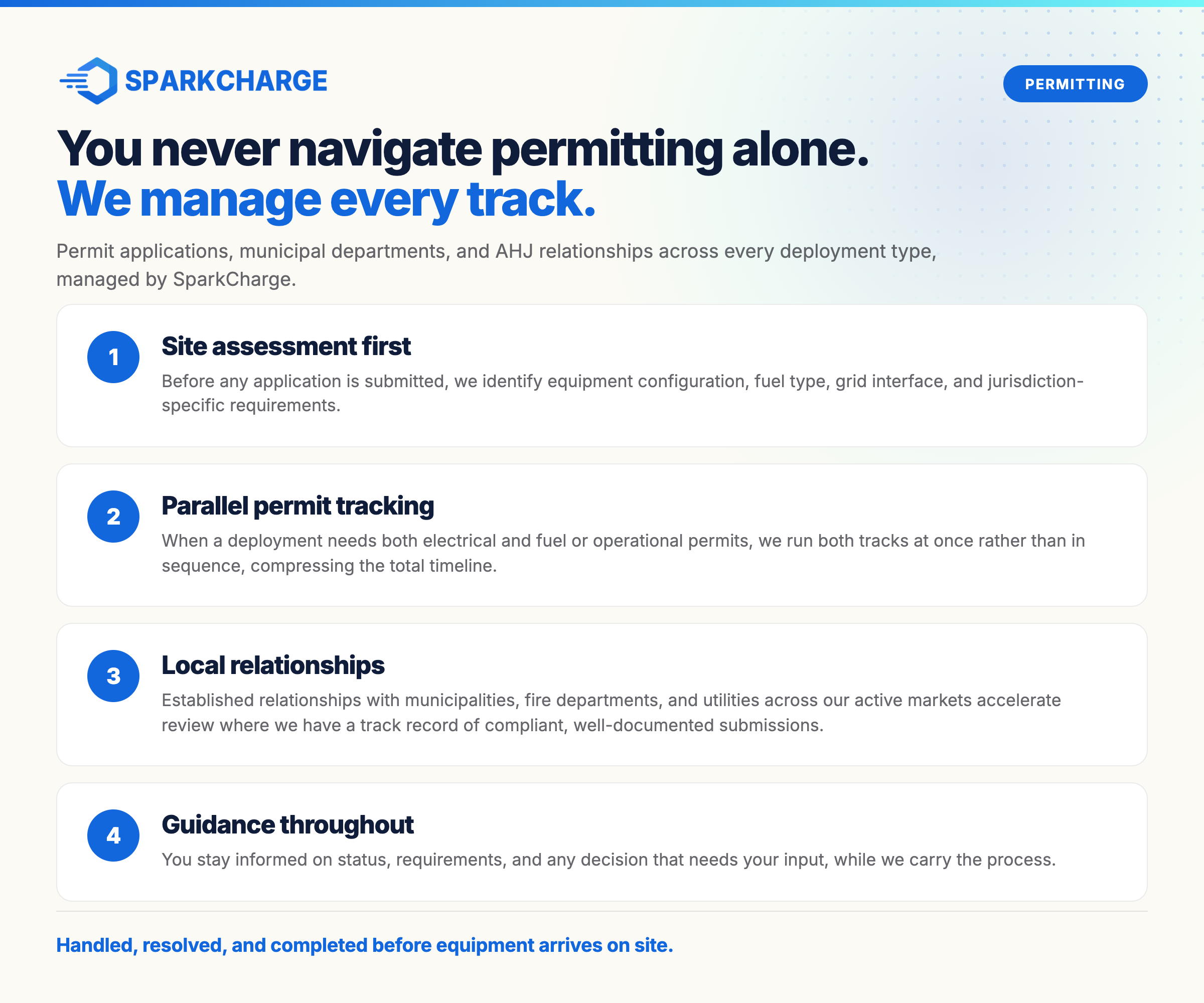
Site assessment first. Before any permit application is submitted, SparkCharge conducts a site assessment that identifies the equipment configuration, fuel type if applicable, grid interface if any, and jurisdiction-specific requirements.
Parallel permit tracking. For deployments requiring both electrical and fuel/operational permits, SparkCharge manages both tracks simultaneously rather than sequentially. This compresses the total timeline.
Local relationships. SparkCharge has established relationships with municipalities, fire departments, and utilities across its active deployment markets. These relationships accelerate the review process in markets where SparkCharge has a track record of compliant, well-documented submissions.
Customer guidance throughout. While SparkCharge manages the process, customers are kept informed of status, requirements, and any decisions that require customer input. The goal is to make permitting invisible to the site operator. Handled, resolved, and complete before the equipment arrives on site.
Can I Permit My Site for Energy Infrastructure?
Not sure whether your location can support on-site energy storage? Use the tool below to check your address and get a preliminary assessment. A SparkCharge energy specialist will follow up to walk you through what your site requires and what deployment options make sense for your operation.

Site Permit Checker
Find out if your site is ready for EV charging or on-site energy storage
Where is your site located?
Permitting requirements vary significantly by city and state. Your location helps us understand what is required for your deployment.
What type of site is this?
Different site types have different permitting requirements. Selecting the right category helps us match the right deployment model.
How much daily energy do you need on site?
Daily energy demand determines the right equipment configuration and scale of deployment. Estimates are fine at this stage.
When do you need to be operational?
Your deployment timeline affects how we approach the permitting process and which equipment configurations are right for your operation.
Where should we send your assessment?
A SparkCharge energy specialist will review your site details and reach out within one business day.
Your information is used only to connect you with a SparkCharge energy specialist. We do not sell or share your data.
Your site looks like a strong fit.
Based on what you have shared, your site is a strong fit for SparkCharge's distributed energy network. A SparkCharge energy specialist will review your details and reach out within one business day.