

5 Ways to Cut EV Fleet Downtime with Mobile Charging
Every hour an electric vehicle (EV) sits idle waiting for a charge is an hour it is not earning. For fleet operators running last-mile delivery, rideshare, rental, or shuttle operations, EV downtime is not a minor inconvenience. It is a direct hit to route completion rates, SLA performance, and revenue per vehicle.
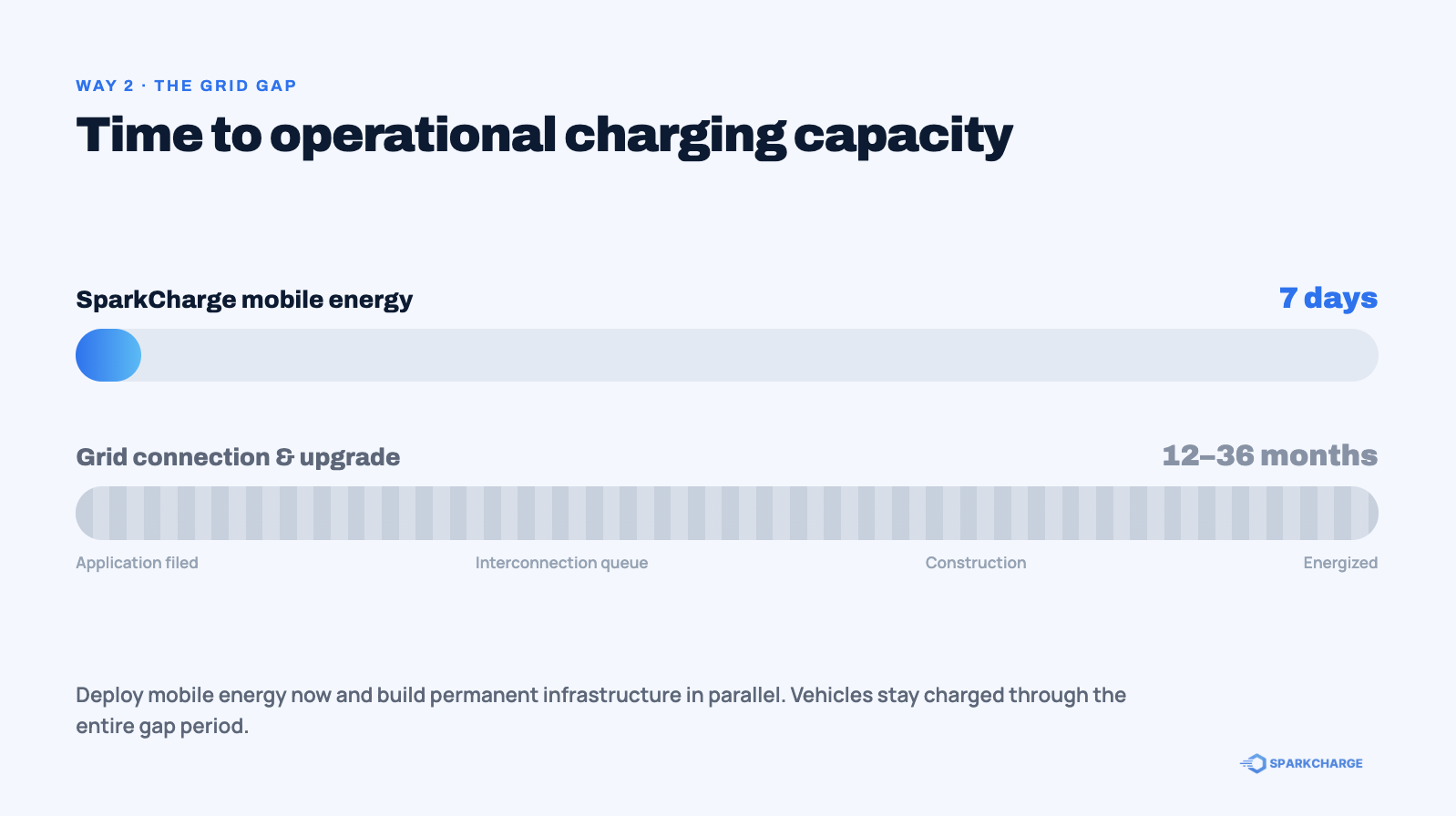
The challenge most operators discover too late is that the charging infrastructure gap is not a charger problem. It is an energy infrastructure problem. Grid connections take 12 to 36 months to secure. Infrastructure upgrades cost hundreds of thousands of dollars per site. And while operators wait, vehicles sit.
Grid-free EV charging infrastructure exists to solve exactly that problem. Here are five ways it cuts EV fleet downtime and keeps operations moving.
The Real Reason EV Fleets Sit Idle
Fleet operators who have switched to electric vehicles know the vehicle side of the equation is solved. Modern EVs are reliable, capable, and built for commercial use. The problem is the energy infrastructure behind them.
The United States electrical grid was not designed to absorb simultaneous demand from fleet electrification, data center growth, and industrial reshoring. Grid upgrade timelines regularly run 12 to 36 months. Infrastructure costs routinely exceed $100,000 per charging station when construction, permitting, and utility work are factored in. And at most commercial fleet depots, the grid simply does not have the capacity to support the level of DC fast charging modern EV fleets require.
The result is downtime that has nothing to do with the vehicles themselves. It is infrastructure downtime. And it is avoidable.
1. Deploy Charging Where the Vehicles Are, Not Where the Grid Is
The most common cause of EV fleet downtime is a mismatch between where vehicles operate and where permanent charging infrastructure can realistically be built. Fleet depots are not always utility-ready. Satellite locations, temporary staging yards, and expansion sites frequently lack the grid capacity to support meaningful EV charging.
Mobile energy infrastructure changes the equation entirely. Instead of designing fleet operations around where the grid allows charging, operators deploy charging where vehicles actually need it.
How Mobile Energy Infrastructure Solves the Site Readiness Problem
Mobile battery charging systems like SparkCharge's Battery Energy Storage Systems (BESS) require no site construction, no utility upgrades, and no delays. They arrive operational and deploy in approximately the footprint of a single parking space. A site that would take 18 months to electrify with permanent infrastructure can be operational with mobile charging in a matter of days.
For fleet operators running multi-site operations or expanding into new territories, this removes the infrastructure dependency entirely. The vehicles go where the routes are. The charging follows.
2. Stop Waiting 18 Months for a Grid Upgrade
The single largest driver of EV fleet downtime is not vehicle failure. It is infrastructure delay. Operators who commit to fleet electrification before their grid connection is ready end up running EVs on insufficient charging capacity, leading to vehicles that are not fully charged at shift start, charging queues that back up during peak hours, and drivers who are forced to wait.
The grid upgrade timeline is not a planning failure on the part of fleet operators. It is a structural constraint. Utilities across the country are managing interconnection queues that run years deep. A fleet operator who applies for a grid upgrade today may not have operational capacity for 12 to 36 months, even if the vehicles are already on the road.
What Operators Are Doing Instead
The operators cutting downtime in 2026 are not waiting for the grid. They are deploying mobile energy infrastructure immediately and building permanent infrastructure in parallel when the grid connection eventually arrives.
This approach keeps vehicles charged and operational throughout the gap period. SparkCharge deploys energy infrastructure in 7 days. It is the operational reality for fleet partners including Amazon, Hertz, Uber, and DHL. The grid has a timeline. The operation does not.
3. Scale Charging Capacity as Your Fleet Grows
Fleet electrification is not a one-time infrastructure decision. Most operators start with a pilot, scale to a partial fleet, and eventually convert entirely. The problem with permanent infrastructure is that it is sized for a point in time. A depot built for 50 vehicles becomes a bottleneck when the fleet reaches 150.
Mobile charging infrastructure scales with the operation. Operators add capacity when they need it, at the sites where they need it, without redesigning the underlying infrastructure or triggering new utility applications.
The Modular Approach to Fleet Energy
SparkCharge's product line is designed to scale in stages. Battery Energy Storage units handle flexible deployment and pilot-stage operations. These BESS units supports high-power DC fast charging at larger depots with significant daily throughput requirements. PowerHub generation systems provide continuous on-site energy for operations that cannot tolerate any gap in charging availability.
Operators are not locked into a single system configuration. As the fleet grows, the energy infrastructure grows with it. No stranded assets. No infrastructure that is out of scale on day one.
The Charging-as-a-Service model converts infrastructure from a capital decision into an operating cost. Operators have a fixed equipment and costs per kWh, with no demand charge surprises and no upfront capital commitment. For fleet operators managing OpEx budgets and quarterly approval cycles, this is the procurement model that permanent infrastructure has never offered.
4. Eliminate Charging Bottlenecks With AI-Optimized Energy Management
Downtime is not always caused by a charger that is offline. It is frequently caused by a charging system that is not optimized for the way the fleet actually operates. Vehicles returning from routes in waves, overnight charging windows that do not align with grid pricing, and depot layouts that create queuing inefficiencies all contribute to vehicles that are not charged and ready when shifts begin.
AI-optimized energy management addresses these problems before they cause downtime.
How SparkAI Reduces Downtime Before It Starts
SparkAI analyzes more than 500 real-world data points including fleet mix, vehicle specs, route patterns, depot layout, available power sources, and local climate conditions. In under 60 seconds it generates a custom infrastructure plan that accounts for how the operation actually runs, not how a generic deployment template assumes it does.
The result is infrastructure that is sized correctly from the start, positioned to minimize charging queues, and configured to reduce energy costs by 15 to 30 percent. That is downtime reduction before a single vehicle plugs in.
For fleet operators who have experienced the slow and expensive process of traditional infrastructure planning, SparkAI compresses a weeks-long assessment into a same-day deliverable. The infrastructure plan arrives before the meeting ends.
5. Replace Reactive Maintenance With 24/7 Autonomous Monitoring
The most expensive kind of EV fleet downtime is the kind nobody sees coming. A charging system that fails overnight leaves an entire shift of vehicles undercharged by morning. A power source that drops during peak charging hours creates a queue that ripples through the entire day's route schedule.
Reactive maintenance is the default at most fleet depots. A problem is discovered when it affects operations. By the time it is reported, diagnosed, and resolved, the damage to vehicle availability is already done.
What 99.9% Uptime Actually Looks Like in Operation
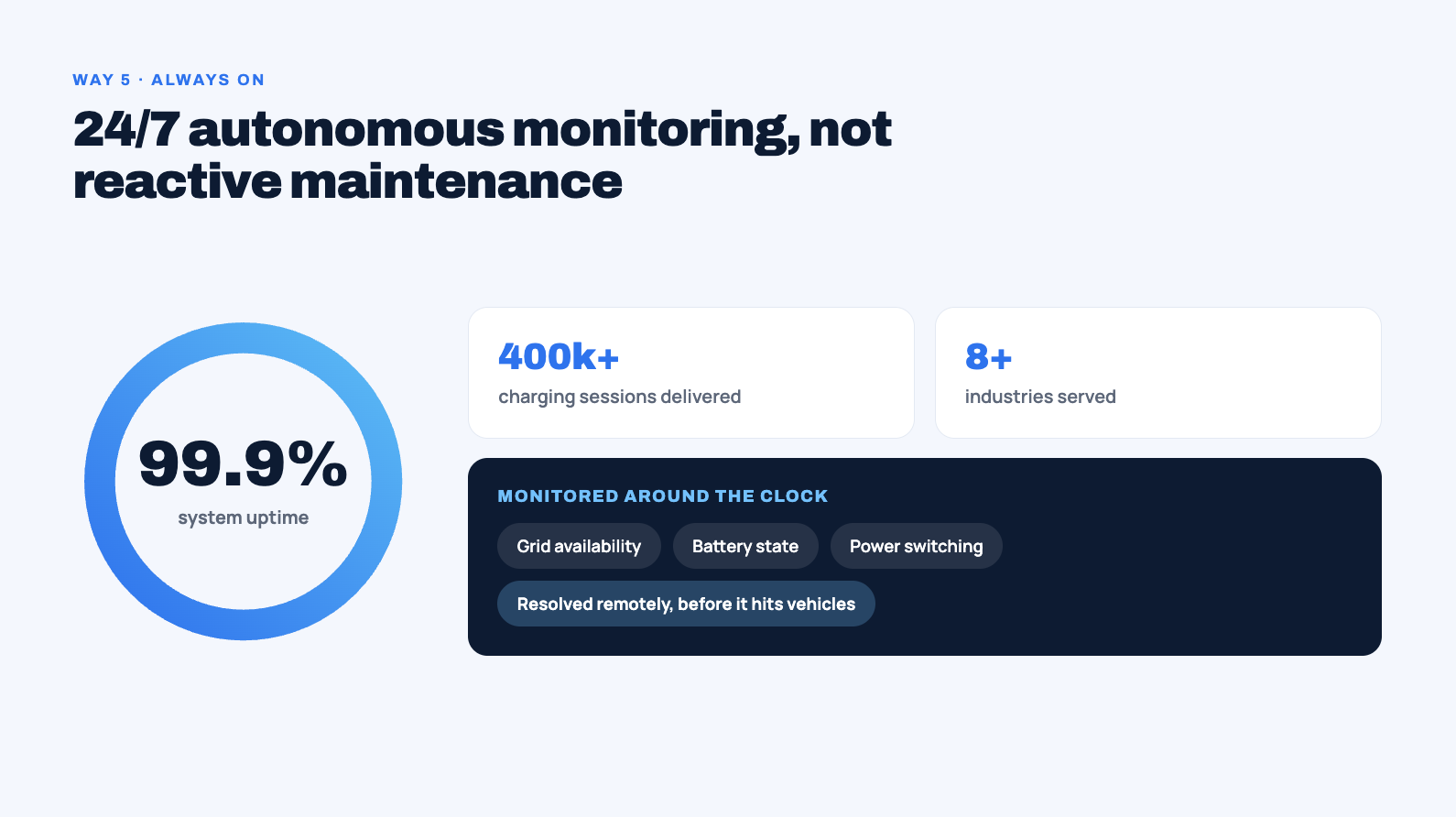
SparkCharge monitors every deployed energy system around the clock. It tracks grid availability, battery state, power source switching, and system performance in real time. When an issue is detected, SparkCharge resolves it remotely before it reaches the threshold of affecting vehicle availability.
It is autonomous energy management that keeps systems running . Fleet operators do not add an energy management function to their team. SparkCharge is the energy management function.
The outcome is 99.9% uptime across more than 8+ industries and over 400,000 charging sessions delivered. When the charging infrastructure works every time, vehicles are ready every time.
The Bottom Line on EV Fleet Downtime
EV fleet downtime comes from one of five places: wrong-site infrastructure, grid upgrade delays, insufficient capacity for fleet growth, unoptimized energy management, or reactive maintenance that arrives too late. Mobile energy infrastructure addresses all five directly.
The operators who are running the most reliable EV fleets in 2026 are not the ones who built the most permanent charging infrastructure. They are the ones who deployed the right energy infrastructure at the right sites, at the right time, without waiting for the grid to catch up.
Ready to cut EV fleet downtime? SparkCharge deploys mobile energy infrastructure in 7 days at fleet depots across the country.
Talk to a fleet energy specialist or request a SparkAI infrastructure plan for your operation.