
Why Batteries and Flexible Fuel Microgrids Are Becoming the New Energy Infrastructure
Enterprise energy demand is growing in four directions at once: AI compute, fleet electrification, industrial reshoring, and climate-driven load in regions that once had predictable, moderate consumption. The grid was sized for one of those pressures. Not all four simultaneously.
The numbers make the gap concrete. The US Energy Information Administration projects record electricity consumption rising from 4,097 TWh in 2024 to 4,283 TWh in 2026, with commercial data centers and industrial sectors leading growth. Data center expansion alone is expected to account for approximately 50% of US demand growth through 2030, according to the International Energy Agency. Reshoring of supply chains and industrial activity could contribute up to 10 GW of additional electricity demand by 2030, while transportation and heating electrification could add another 20 GW.
Utilities are investing; utility capital investment reached $179 billion, an all-time high. But capital investment in generation and transmission does not translate to available power on any enterprise's timeline. In Northern Virginia, home to the world's largest concentration of hyperscale facilities, new loads can face a 14-year wait for a grid connection, even as utilities collectively plan $208 billion in grid capital expenditure for 2025 alone.
Battery Energy Storage Systems and flexible fuel microgrids have emerged as the infrastructure response to that gap. Not as temporary workarounds but as a permanent, evolving layer of the energy system. Understanding how they work, why they matter now, and where they are heading is increasingly a strategic requirement for any enterprise making long-term energy decisions.
Four Demand Drivers. One Grid. A Growing Gap.
US electricity demand surged in 2025 due to the rise of AI-driven workloads, transportation and industrial electrification, and growing data center operations. Utilities are struggling to keep up, as grid reliability is threatened by an imbalance between rapid demand growth and slow supply expansion.
Following a record year in 2024, when more than 10 gigawatts of utility-scale battery storage were installed nationwide, deployment accelerated even further in 2025. By mid-2025, year-to-date battery installations had already exceeded the total of 2024's additions. That pace of deployment is not a coincidence. It reflects a growing consensus among utilities, enterprises, and infrastructure investors that centralized grid power alone cannot meet the energy demands of the next decade.
The future electric grid is expected to be comprised of more than 35% of distributed energy resources, with a significant majority expected to be in microgrid configurations. The transition from a centralized grid model to a distributed one is already underway. Battery storage and microgrids are not a fringe response to a temporary problem. They are the architecture of what the grid becomes.
What Batteries Actually Do for the Grid and for You?
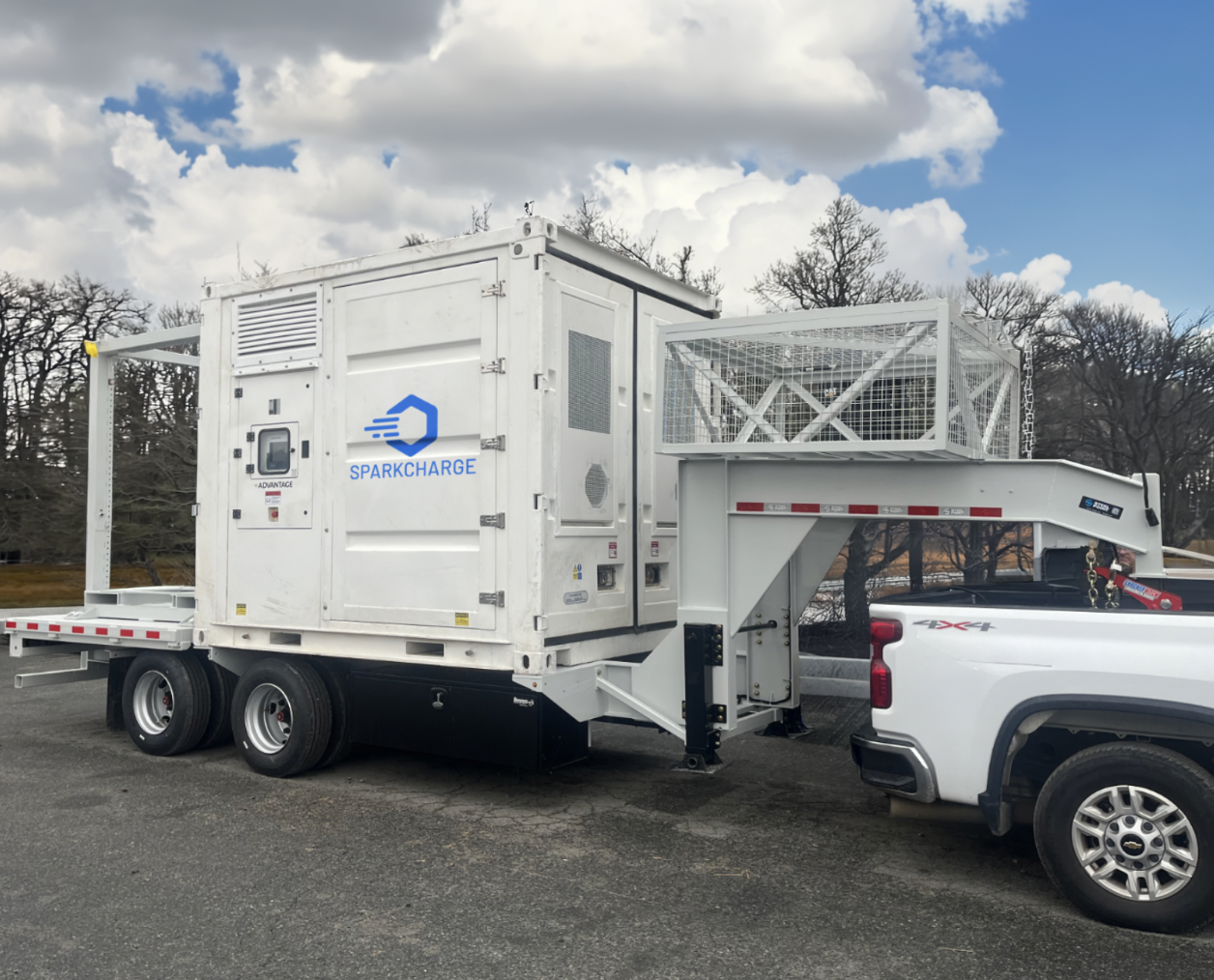
Battery Energy Storage Systems (BESS) are frequently described as backup power. That framing is incomplete. The more important story is what BESS does during normal operations, before any outage or emergency event.
Peak Shaving and Demand Charge Elimination
Utilities bill large commercial customers based on their peak power draw within a billing period. A single 15-minute window of high demand can set the demand charge for the entire month, regardless of how efficiently energy was used the rest of the time. For energy-intensive operations, demand charges routinely represent 30 to 50% of the total electricity bill.
BESS eliminates this exposure by capping peak draws automatically. The battery management system monitors consumption in real time and dispatches stored energy at the precise moment demand would otherwise spike, smoothing the load curve and cutting the demand charge before it is recorded. Beyond emergency support, BESS systems reduce operational costs through peak shaving, load shifting, voltage support, and improved grid stability.
Grid Support as a Revenue Stream
Beyond cost reduction, grid-tied BESS can generate revenue. In wholesale energy markets, behind-the-meter battery assets can participate in demand response programs, frequency regulation, and capacity markets, dispatching stored energy back to the grid when it is needed most and being compensated for doing so.
Grid-scale battery storage is becoming essential for integrating sustainable energy, stabilizing grids, and unlocking new revenue streams from peak shaving and ancillary services. An enterprise that installs BESS for operational reasons inherits a grid-support asset that can generate income from capacity that would otherwise sit idle.
Resilience Without Interruption
For enterprises where downtime is not an option, BESS delivers backup power with response times measured in milliseconds. No manual intervention. No startup delay. No dependency on a fuel delivery that may not arrive during the event that triggered the outage.
When paired with on-site generation, the combination creates a layered resilience architecture: BESS handles instantaneous load transitions while generation sustains operations over longer durations. Neither system relies on the grid being available. Together, they ensure continuity regardless of what the utility is doing.
The cost of an unplanned outage at an electric vehicle (EV) or Autonomous Vehicle (AV) fleet depot, data center, or industrial site is not abstract. BESS and on-site generation eliminate the single point of failure that grid dependency creates.
The result is a facility that does not just survive grid disruption. It operates through it.
What Is a Flexible Fuel Microgrid and Why Does It Matter Now?
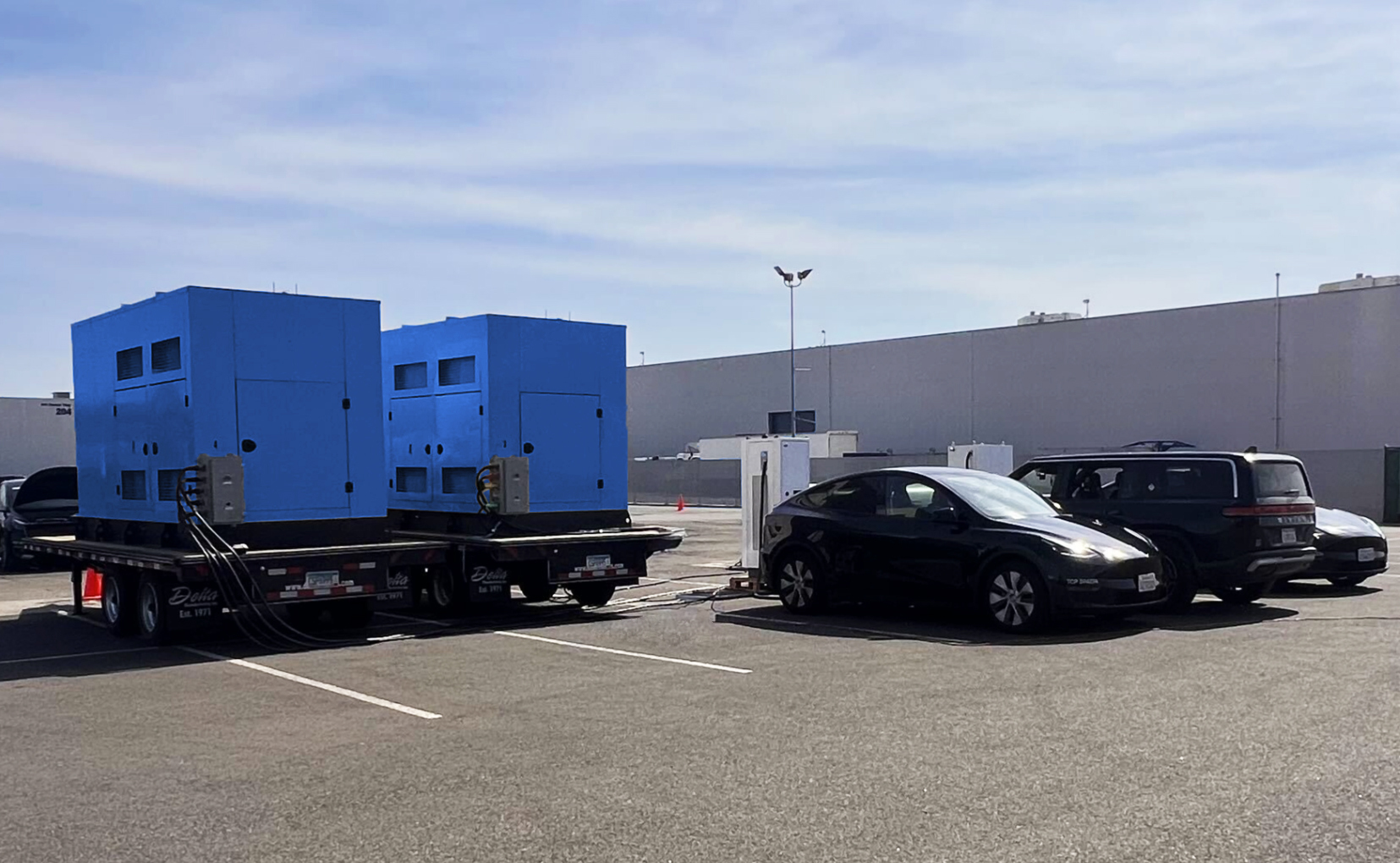
A microgrid is a localized energy system that can operate independently from the main grid, or in coordination with it. It combines generation sources, energy storage, and intelligent controls into a self-managing energy network that serves a specific site or facility.
The flexible fuel designation refers to microgrids that can run on more than one fuel type. That flexibility gives operators the ability to optimize for cost, availability, and emissions depending on market conditions and regulatory environment.
How Microgrids Support the Grid Without Replacing It
The most important reframe for enterprise operators evaluating microgrids is the distinction between grid independence and grid support. A microgrid is not a rejection of utility power. It is a complement to it.
Microgrids are capable of supporting the utility during periods of heavy strain on the grid. A key benefit is that everything is local. There is no requirement to build out expensive transmission lines.
The future-ready approach involves reducing reliance on the main grid by managing distributed energy resources and storage locally, while enhancing demand response through dynamic load balancing and storage dispatch.
When a microgrid operates alongside the grid, it reduces the load burden on constrained transmission infrastructure, defers the need for expensive grid upgrades, and provides the utility with a flexible demand resource it can call on during peak events. The enterprise gets energy independence and cost control. The utility gets a more manageable load. Both sides benefit.
Utilities are turning to collaboration with data centers and enterprises as flexible grid partners, using AI-driven optimization and new financing models to address unprecedented capital needs and reliability pressures.
Fuel Options, Carbon Intensity, and How They Compare to the Grid
Carbon intensity (CI) is the measure of greenhouse gas emissions produced per unit of energy, expressed in grams of CO2 equivalent per megajoule (gCO2e/MJ). It is the most useful metric for comparing the emissions profile of different fuel options against each other and against grid electricity.
Understanding CI scores matters for two reasons: regulatory compliance and strategic positioning. Enterprises with carbon commitments need to know what their fuel choices actually cost in emissions terms. The EPA's national average carbon dioxide output rate for delivered US electricity is approximately 394 kg CO2 per MWh, or roughly 109 gCO2e/MJ after accounting for transmission and distribution losses, per the EPA Greenhouse Gas Equivalencies Calculator (2024). That figure varies significantly by region and time of day, but it serves as the baseline against which fuel alternatives should be measured.
Renewable Propane
Renewable propane is produced from waste-based feedstocks including plant oils, animal fats, and used cooking oil, using the same hydrotreatment process as renewable diesel.
Renewable propane made from camelina oil carries CI scores between 20.5 and 43.5 gCO2e/MJ, lower than the electric grid in 49 states. Renewable propane from other feedstocks carries a CI score lower than the electric grid in 45 states. Even conventional propane, at 80 gCO2e/MJ, is lower than the electric grid in those same 45 states, according to the Propane Education and Research Council.
For microgrid operators in most US markets, renewable propane offers a substantially lower emissions profile than drawing from the grid, while retaining the portability, storability, and energy density that makes propane a practical fuel for distributed generation.
Renewable Natural Gas (RNG)
Renewable natural gas is methane captured from biological sources: landfills, wastewater treatment facilities, agricultural operations, and food waste. Rather than releasing that methane into the atmosphere, it is captured, processed to pipeline quality, and used as a fuel.
According to a life cycle analysis published in ACS Omega in January 2026, RNG transport by pipeline carries the lowest CI score over medium to long distances due to the high energy efficiency of the transmission network. Compressed RNG tube trailers carry CI scores as low as 3.2 gCO2e/MJ over shorter distances.
When RNG is sourced from landfill gas or agricultural waste, its lifecycle CI score can be deeply negative, meaning its use as fuel actually reduces net emissions compared to the methane that would otherwise have been released. For enterprises seeking to minimize Scope 1 emissions from on-site generation, RNG is among the cleanest commercially available fuel options.
Hydrotreated Vegetable Oil (HVO)
HVO is a renewable drop-in replacement for diesel, produced by treating waste vegetable oils, animal fats, and used cooking oil with hydrogen at high temperatures and pressure. It is chemically similar to fossil diesel and requires no engine modifications to use.
Life cycle assessments published in ScienceDirect in May 2026 indicate that HVO can achieve 60 to 95% CO2 reductions compared with fossil diesel, depending on feedstock origin. HVO can be used in tandem with a variety of other energy production sources to significantly reduce CO2 emissions while still meeting peak electricity demands, according to Energy Central's June 2026 analysis.
For microgrid operators who need a direct diesel replacement with a substantially lower emissions profile, HVO is the most practical transition fuel currently available at commercial scale.
How These Fuels Compare to the Grid
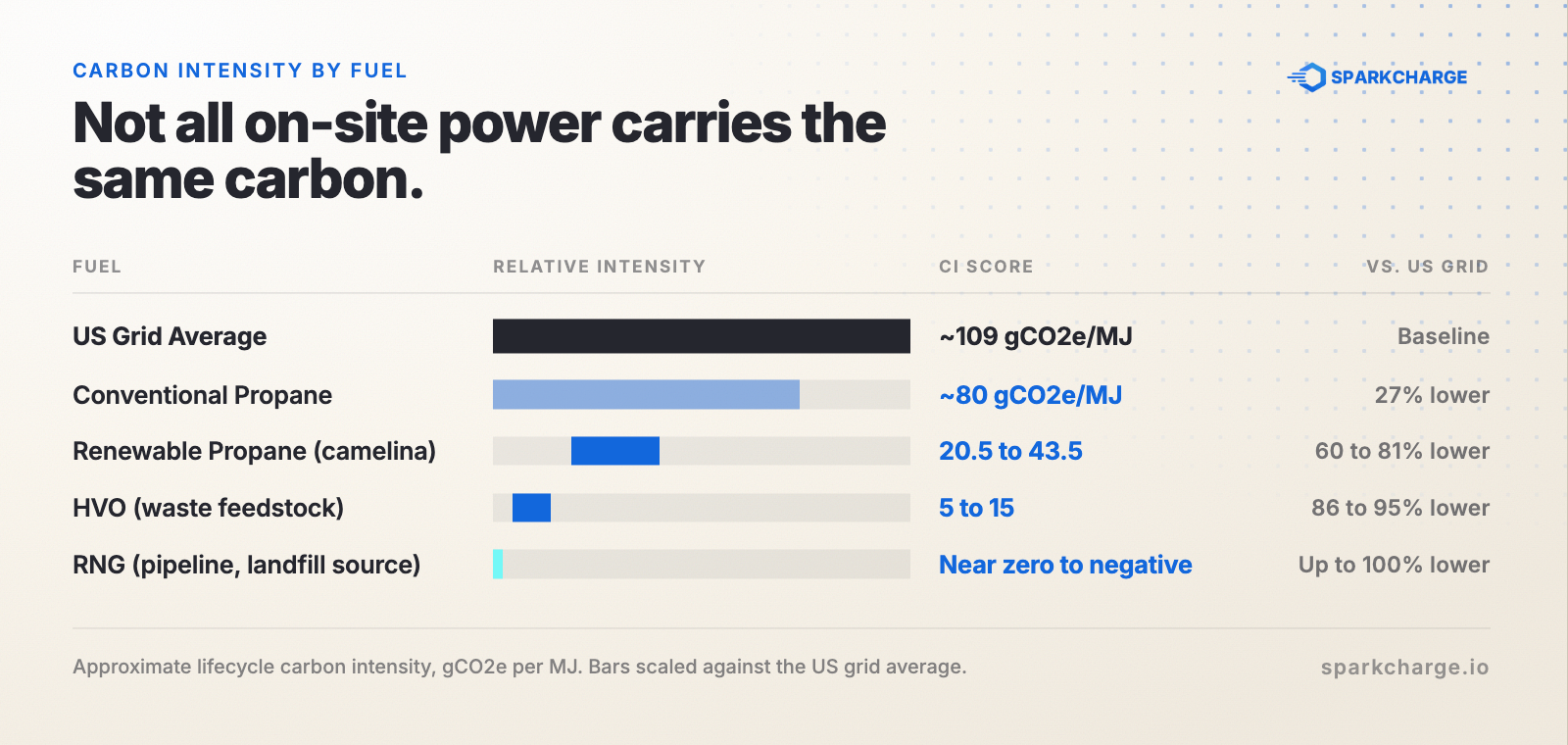
Sources: PERC (propane), ACS Omega 2026 (RNG), ScienceDirect 2026 (HVO), EPA Greenhouse Gas Equivalencies Calculator 2024 (grid baseline)
The takeaway is direct: a well-configured flexible fuel microgrid running on RNG or HVO can deliver on-site power with a materially lower emissions profile than drawing from the US grid in most markets. In many configurations, it is a meaningful step change, not a marginal improvement.
Fuel Efficiency, Battery Integration, and Why Active Load Management Changes the Math
Selecting the right fuel is the first lever. How that fuel is consumed is the second, and it is often the more powerful one.
H3: How Fuel Efficiency Actually Works in On-Site Generation
On-site generators do not operate at a fixed efficiency rate. Their fuel consumption per unit of energy output changes significantly depending on how hard they are working. The fuel efficiency of a generator increases when it is run closer to full load capacity. Running a generator at low load factors, well below its rated output, wastes fuel and increases emissions per kWh produced.
This is a common and costly problem in standalone generation deployments. A site that sizes a generator for peak demand will run that generator at partial load the majority of the time, burning more fuel per kWh than necessary across the entire operating period.
How Pairing a Battery Changes the Efficiency Equation
Connecting a BESS to an on-site generator solves the load factor problem directly. Rather than throttling the generator up and down to chase variable site demand, the generator runs at or near its optimal load point continuously, charging the battery when site demand is low and drawing from the battery when demand spikes.
AI-driven load management allows for dynamic optimization of battery charging and discharging cycles, reducing fuel consumption by an additional 8 to 15% compared to traditional rule-based control systems. For remote sites where fuel logistics are high-cost, these savings translate directly into improved project economics.
The efficiency gains compound over time. A generator running consistently at its optimal load point also runs cleaner, with lower maintenance intervals and longer operational lifespan than one cycling between partial and peak load throughout the day. Lower fuel burn. Lower emissions. Lower total cost of ownership.
Active Load Management: How SparkCharge Takes It Further
Hardware efficiency is the floor. Active load management is the ceiling.
SparkCharge monitors the full energy system in real time: generation output, battery state of charge, site load profile, grid availability and pricing, and energy market conditions. Making dispatch decisions continuously and autonomously, coordinating generation and storage to keep fuel consumption at its most efficient point while ensuring the site always has the power it needs.
When grid power is available and cost-effective, SparkCharge draws from it and uses generation to charge the battery rather than serve the load directly. When the grid is expensive or unavailable, it switches to battery dispatch and runs generation at its optimal point to recharge. When site demand spikes, it smooths the draw with battery power rather than ramping generation into inefficient territory.
Real-time demand response and dynamic load balancing can enhance energy flexibility by up to 30% compared to static dispatch systems, according to Frost and Sullivan's 2026 grid modernization analysis.
The result is a system where the fuel, the battery, and the load are continuously coordinated rather than operating independently. Every kilowatt-hour of fuel produces more usable energy. Every dollar of fuel spend goes further. And the emissions profile of the entire system improves without changing the fuel type at all.
From On-Site Power to Grid Asset: Where Distributed Energy Goes
The trajectory of the energy industry points in one direction: more distributed generation, more storage, and smarter coordination between the two.
Grid buildout is underway. The Bipartisan Infrastructure Law and Inflation Reduction Act have directed hundreds of billions toward transmission expansion, grid modernization, and renewable generation. Over a 10 to 20-year horizon, the US grid will be materially cleaner, more resilient, and more capable than it is today.
But enterprises operating today cannot wait 20 years for that outcome.
The combination of storage, smart controls, and microgrid design is becoming standard practice in 2026. Buyers are now evaluating lifecycle costs, upgrade paths, modularity, and microgrid integration, going well beyond simple price comparisons.
The operators building flexible fuel microgrids and battery storage infrastructure today are not just solving a near-term energy access problem. They are building the distributed energy layer that integrates with the improved grid when it arrives. BESS deployed for demand charge management or pre-grid power today becomes a grid-tied asset that provides peak support, frequency regulation, and demand response tomorrow. Microgrids built for energy independence become coordinated nodes in a smarter, more distributed grid architecture.
Utilities are actively developing strategies to treat large energy users as flexible grid partners rather than passive load, using AI-driven optimization and service-based contracting to manage reliability at scale. The enterprises that build distributed energy infrastructure now arrive at that future with assets already in place. The ones that wait will be building in a more competitive, more expensive environment.
The transition is not from microgrids to the grid. It is from isolated microgrids to coordinated distributed energy networks. The infrastructure decisions made today determine which side of that transition an enterprise lands on.